
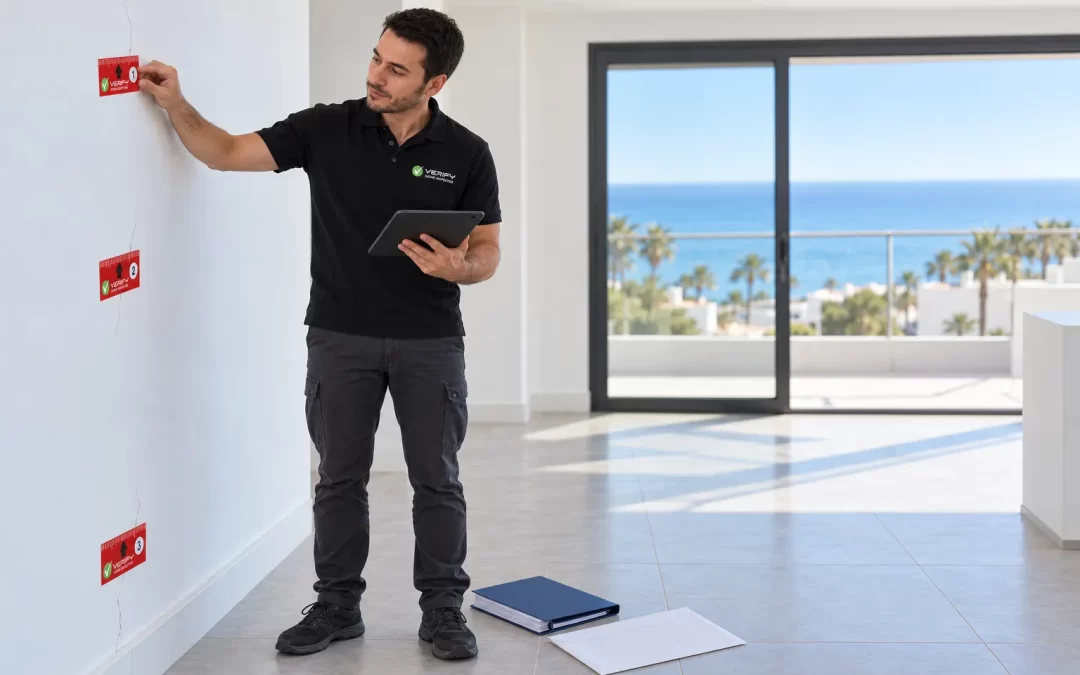
You have bought a brand-new home in Spain, you have the keys, and you have found defects. Or you have not looked yet, and you are about to. This guide, written by Spanish court expert witnesses, explains in plain English what Spanish law gives you, how long you have, what to send, how to send it and what to do if the developer does not answer. It follows the exact steps that a Spanish judge expects to see if the case ever reaches court.
Before you start. This guide is general information prepared by court expert witnesses, with every law linked to its official text in the Spanish Official State Gazette (BOE), consulted in October 2026. It does not replace advice from a Spanish lawyer on your specific case, who should review your contract and documents, especially before going to court.
The essentials in ten points
- The developer who sold you the home is liable to you for its defects, jointly with the builder and the technical team.
- The guarantees of the Spanish Building Act (one year for finishes, three for habitability and ten for structure) run from the formal acceptance of the works, which is usually earlier than the day you get your keys.
- On top of those guarantees, you have a claim for breach of contract, which expires after five years.
- Everything promised in the specifications document (memoria de calidades) and the advertising is binding, even if it is not copied into your contract.
- No law requires a specific form to make a claim. An email is valid, but a burofax with certified content is the strongest proof short of a notary.
- The developer may offer you its after-sales web portal, but it cannot make the validity of your claim depend on it.
- Claim each defect specifically and with a number. A defect claimed for the first time in court can be declared time-barred.
- Let the developer inspect the home before repairing. Refusing access works against you.
- Since April 2025, you must attempt a negotiation before going to court. A well-written burofax does that job.
- If the developer does not repair, you can claim the cost of the repair. Repairing it yourself first is possible, but only with the precautions explained in step 5.
Who to claim against: developer, builder and technical team
You signed your contract with the developer (the promotora), and that is who you claim against first. Article 17.3 of the Building Act (Ley de Ordenación de la Edificación, LOE) states that the developer is always jointly liable with the other parties for material damage caused by construction defects. In practice, you can demand everything from the developer, even if the fault lies with the builder, a subcontractor or the site management.
Send a copy of your claim to the builder as well. The Spanish Supreme Court has recalled that claiming against one party does not automatically interrupt the time limit against the others (judgment 1463/2025 of 21 October). The builder’s name appears in the Building Book (Libro del Edificio) and in the project documents.
Defects in common areas (façade, roof, entrance, garage, gardens, pool) are claimed by the owners’ association, as explained further below.
The time limits you must watch
Several different time limits apply to a new-build claim. Mixing them up is the most expensive mistake a buyer can make, because a defect claimed too late may never be repaired, however obvious it is.
| Time limit | What it covers | Counted from | Law |
|---|---|---|---|
| 1 year | Workmanship defects in finishes | Acceptance of the works | LOE, art. 17.1 |
| 3 years | Defects in building elements or installations that affect habitability, including watertightness | Acceptance of the works | LOE, art. 17.1 and art. 3.1.c |
| 10 years | Structural damage affecting strength and stability | Acceptance of the works | LOE, art. 17.1 |
| 2 years | Time to bring the Building Act claim once the damage appears. Interrupted by any written claim | When the damage appears | LOE, art. 18.1 and Civil Code, art. 1973 |
| 5 years | Breach of contract claim against the developer, for example anything that does not match the specifications | When performance can be demanded | Civil Code, art. 1964.2 |
| 15 days | Maximum time for the company to answer your claim | When you submit the claim | Consumer Law, art. 21.3 |
| 30 calendar days | Without an answer to your negotiation request, the prior negotiation is deemed attempted and you can go to court | When the developer receives the request | Organic Law 1/2025, art. 10.4 |
| 1 year | Time to file the lawsuit after the negotiation attempt | Receipt of the request or end of the negotiation | Organic Law 1/2025, art. 7.3 |
The date trap: acceptance of the works versus handover of keys
The acceptance of the works (recepción de la obra) is an act between the developer and the builder, not with you. Article 6.5 of the Building Act states that the guarantee periods start from the date the acceptance certificate is signed. If the development was finished months before you received your keys, part of your one-year finishing guarantee has already gone. Ask the developer in writing for the date of the acceptance certificate. It usually appears in the Building Book too.
Two important details. First, the guarantee periods of 1, 3 and 10 years are the window in which the defect must appear, and the two-year period to sue is a different one that starts when the damage appears; the Supreme Court distinguishes both (judgment 13/2020 of 15 January). Second, the five-year breach of contract claim remains available even after the one-year finishing guarantee has expired. The Supreme Court ordered a developer to pay for cracks, damp, carpentry and sanitary ware outside the one-year guarantee, because those defects were not consistent with delivering a new home fit for use (judgment 403/2016 of 15 June). The developer is contractually liable to deliver a home fit for use regardless of the size of the defects (judgment 666/2026 of 4 May).
Every written claim stops the clock
Under article 1973 of the Civil Code, the limitation period is interrupted by a court claim, by an out-of-court claim from the creditor and by any acknowledgment of the debt by the debtor. A request for prior negotiation has the same effect (Organic Law 1/2025, art. 7.1). That is why your claim must be specific: in a 2026 judgment, the Provincial Court of Barcelona accepted the claims sent to a developer by burofax and email, but declared time-barred the defects that were claimed for the first time in the lawsuit (judgment 41/2026 of 2 February).
The laws that protect you
| Law | Key articles | What it does for you |
|---|---|---|
| Building Act, Ley 38/1999 (LOE) | 3.1.c, 6, 9, 17, 18 and 19 | Building requirements, acceptance of the works, developer’s duties, the 1, 3 and 10-year guarantees, joint liability, the 2-year period and insurance. For homes, only the 10-year structural insurance is compulsory. |
| Civil Code | 7, 1091, 1098, 1100, 1101, 1124, 1256, 1258, 1964.2 and 1973 | Good faith, binding force of the contract, performance at the expense of the party in breach, default from the claim, damages, the 5-year period and interruption of limitation. |
| Consumer Protection Law, RDL 1/2007 (TRLGDCU) | 10, 21, 61, 82, 86 and 87 | Your rights cannot be waived, the company must accept claims by post, phone and electronic means and answer within 15 days, advertising and specifications are binding, and terms that limit your rights are unfair. |
| Customer Service Law, Ley 10/2025 | 3.10, 7, 13 and 17 | For large companies: mandatory channels and reasoned answers within 15 working days. An «incident» is a claim, whatever the company calls it. Companies have until 28 December 2026 to adapt. |
| Royal Decree 515/1989 | 2 and 3.2 | The construction features, installations and services advertised are binding even if they are not in the contract. |
| Spanish Building Code, RD 314/2006 (CTE) | Basic documents on safety, health, energy and noise | The technical requirements the building must meet. The expert uses them to justify why something is a defect. |
| Organic Law 1/2025 | 5, 7, 10, 14 and 7th additional provision | Duty to attempt a negotiation before suing, how to prove it, the 30-day and one-year periods and a special rule for consumers. |
| Civil Procedure Act, Ley 1/2000 (LEC) | 31, 241, 249, 250, 335, 336 and 394 | Lawyer and court representative above 2,000 euros, type of trial, expert report filed with the lawsuit and under oath, and legal costs. |
| Horizontal Property Act, Ley 49/1960 | 13.3 | The president of the owners’ association represents it to claim defects in common areas. |
Each Spanish region also has its own consumer law. In the Valencian Community, where Alicante, Torrevieja, Orihuela Costa and Benidorm are located, the Building Quality Act, Ley 3/2004 (LOFCE) prevents the user and maintenance instructions from being used to shift the builders’ liability onto the owner (article 24.3). Andalusia and the Region of Murcia have their own consumer statutes with similar protections. Read more in our pages on the Building Act guarantees and Spanish consumer protection law.
The documents you need
Before you claim, put these documents in one folder, on paper and in digital form. They are the yardstick for what you were given and the basis of the expert report.
- Purchase contract and its annexes, and the public deed of sale (escritura).
- Signed specifications document, sales brochures, finishes catalogue and dated screenshots of the development’s website.
- Floor plans, especially the air-conditioning plan, and the usable and built areas.
- The handover document and any snagging list you signed.
- The user and maintenance manual, the Building Book, installation certificates and the energy performance certificate.
- Every communication with the developer: emails, messages, after-sales replies and screenshots of its portal.
- Full company details of the developer and the builder: company name, tax number (CIF) and registered address.
Step 1. The inspection and the expert report
Everything starts with knowing exactly what is wrong. A list you make with your phone has some value, but an expert report is a different thing: it is evidence that a judge assesses, signed by a professional who declares under oath that they have acted objectively (Civil Procedure Act, art. 335.2), and it is filed together with the lawsuit (art. 336). To work for both negotiation and court, the report must have:
- A code for every defect (INC-1, INC-2…), its location and its photograph, so that each one can be claimed, repaired and checked separately and nobody can say the claim is «generic».
- A description and the cause, with reference to the technical standard or the specifications point that is breached.
- The severity and the technical solution required.
- A valuation item by item at real market prices, only for work that genuinely has to be done. Over-claiming is the fastest way to make a judge distrust the whole report.
- A comparison with the specifications, also recognising anything delivered better than promised.
- A full inventory of photographs, videos and documents, and the expert’s oath.
A practical tip: ask the expert for the list of defects in a spreadsheet too. Offering it to the developer to load into its system shows good faith and removes the excuse of asking you to type everything again.
Step 2. The email to the developer
The first contact can be an email with the report attached. It is quick, free and, if the developer replies from its own domain, well documented. In court an email is documentary evidence: if the other side does not challenge it, it counts like any private document (Civil Procedure Act, art. 326); if it does, you will have to prove its authenticity. That is why the email is the first step and the burofax the second. Keep the email in your mailbox, save it in .eml format and keep every reply.
The email should be written in Spanish. In essence, it must say:
- That you are the owner of the home, with its full address, and the date you received it.
- That you attach the expert report, with its date, the expert’s name and the number of defects, coded INC-1 to INC-X.
- That you formally claim the repair of all of them under the contract, the specifications and article 17 of the Building Act. The words «formally claim» matter: they interrupt the limitation period and put the developer in default (Civil Code, arts. 1973 and 1100).
- That you ask for a claim reference number, proof of receipt and a reasoned written answer for each defect, which the company must give you within 15 days (Consumer Law, art. 21).
- That you offer the list in a spreadsheet and the home for a technical visit on specific days.
- That you ask for the date of the acceptance certificate.
Can the developer force you to use its after-sales portal?
It is the answer we are seeing most often. You send the expert report and the developer replies that its procedure requires each defect to be entered one by one on its website, and that until you do, nothing has started. With 80, 100 or 140 defects, that means hours in front of a form.
The developer is right about one thing: it has the right to check the defects before repairing them, so you must let it visit. Refusing access is a mistake a judge will not overlook, because rights must be exercised in good faith (Civil Code, art. 7).
It is wrong to make the validity of your claim, or the start of the time limits, depend on its portal:
- No law requires a specific form to claim. The Supreme Court repeats that an out-of-court claim «requires no particular formality» (judgment 529/2024 of 22 April and judgment 1550/2023 of 8 November, the latter on construction defects).
- Consumer law obliges the company to accept claims by post, phone and electronic means (TRLGDCU, art. 21.3), and for large companies Ley 10/2025 states that they «must accept» those channels (art. 7.1).
- A single compulsory channel would be unfair, because it limits consumer rights and imposes disproportionate obstacles to exercise them (TRLGDCU, arts. 86.7 and 87.6).
- The courts accept the burofax and the email, as the Barcelona judgment cited above shows.
In practice: do not retype the defects one by one. If you want to remove the excuse, register a single request on the portal that says «see attached expert report with X numbered defects and claim dated [date]», attach the PDF and ask for a visit through that route. It takes ten minutes. Then answer in writing that your claim was already valid from its date, and send the burofax if there is no reply.
Step 3. The burofax: how it is sent through Correos
If the developer does not reply to the email, replies without addressing the defects or refers you to its portal, the next step is the burofax. Its advantage is that Correos, the Spanish postal service, certifies as a third party the content of what you sent, the date and the delivery. Only a notarial demand is stronger, as a public document (Civil Procedure Act, art. 319), but it is more expensive, especially with a long report attached.
- Who to send it to: the developer, at the registered address in your contract or deed, with a copy to any after-sales address it has given you, and the builder at its registered address.
- What to order: certified copy of the content (copia certificada), which is essential, and proof of delivery (acuse de recibo or electronic proof of delivery).
- The page limit: the online burofax of Correos accepts one PDF of up to 15 MB and 100 pages per shipment. An expert report with photographs is usually close to that limit, so the safest method is two burofaxes on the same day: the first with the demand letter and the numbered list of all the defects, and the second with the full expert report.
- How to send it: online through Mi Oficina de Correos, or at any post office with the document printed in A4. If you are not in Spain, your lawyer or a trusted representative can send it for you.
- What it costs: according to the official 2026 rates of Correos for the mainland and the Balearic Islands, VAT included, an online shipment of 100 pages with certified copy and electronic proof of delivery costs around 195 euros. Check the current rate before sending.
- If nobody collects it: the Supreme Court considers a burofax valid when it is not delivered for reasons attributable to the recipient, without repeating it (judgment 633/2022 of 29 September). Ask Correos for the certificate of attempted delivery.
What the burofax must say: 20 days to act
The burofax, in Spanish, does three jobs at once: it demands the repair within a deadline, it interrupts the limitation period and it serves as the prior negotiation required by Organic Law 1/2025. Its structure:
- Identification. Your details, the developer’s details, the contract and deed dates, and the handover date.
- The expert report. Its date, reference and number of defects, coded INC-1 to INC-X, with the repair valuation and the full numbered list attached as Annex I. This is the most important part: each defect must be claimed specifically.
- Your previous claim. The date of your email, reminding the developer that it was valid from that date because the law requires no particular form.
- Legal basis. Breach of contract and of the specifications (TRLGDCU art. 61 and RD 515/1989 art. 3.2) and liability under article 17 of the Building Act. Citing both lets you choose the best route later.
- The demand. Within 20 calendar days from receipt: repair all the defects in Annex I or send a closed written schedule with actual start of work within that period; propose a date to inspect the home if they wish; and provide a claim reference and a reasoned answer for each defect. Twenty days to start or present a schedule is reasonable. Demanding that 100 defects are finished in 20 days could look disproportionate.
- Prior negotiation request. An express statement that the letter is a request for prior negotiation under Organic Law 1/2025, with its subject: the repair of the defects or, alternatively, payment of their valued cost. The subject must match what you would later claim in court.
- Warning. If the deadline passes without an answer or without work starting, you will have the repair carried out by third parties at their expense (Civil Code, art. 1098), after giving them at least ten days’ notice to inspect the home, and you will claim the cost, damages and legal costs.
- Interruption. An express statement that the letter interrupts the limitation period of all actions, and a reservation of all your rights.
If the amount is high, have your lawyer review the burofax before sending it: that document defines what you can later ask for in court.
Step 4. The developer’s visit and the repairs
- Accept the visit and, if possible, have your expert there. Go through the defects with the same numbering as the report.
- Ask for written minutes of the visit: which defects they accept, which they reject and why. Large companies must give reasoned answers, without generic replies (Ley 10/2025, art. 13.1).
- Never sign a global acceptance. If they give you a closing document, sign only what has been repaired, defect by defect, and record what is pending.
- Check the repairs yourself or with your expert. A painted stain does not prove that a leak has been fixed.
- Rejected defects remain claimed. Ask for the reason in writing and assess it with your expert.
Step 5. If they do not answer: can I repair it myself and claim the money?
Short answer: yes. The Spanish Supreme Court accepts that the buyer may claim money instead of the repair, and even the refund of what they have paid to repair, when the developer was demonstrably asked to repair and failed to do so. It is not automatic: the judge will award what is proven necessary and at market price, and the developer must have had a real opportunity to check and repair. Repairing it yourself does not save you the lawsuit if the developer does not pay.
- You can choose money. The right to demand the repair does not exclude claiming compensation directly (Supreme Court judgment 884/2010 of 21 December), and the repair by the party responsible does not, as a general rule, take priority (judgment 720/2007).
- Requirements: a proven prior demand, failure to comply and the owner’s preference for compensation. Nobody can be forced to live permanently with the inconvenience of construction defects (judgment 601/2005 of 13 July).
- What the owner actually paid to repair can be claimed if the demand was ignored (judgment 287/2012 of 11 May).
- Ineffective repairs count against the developer, which can lose the privilege of carrying out the repairs with its own means (judgment 410/2002 of 7 May).
- Urgent repairs, such as a water leak or water coming in, should not wait: document them and fix them. The Supreme Court awarded an owner the cost of urgent works paid after the parties responsible failed to collect the burofaxes (judgment 625/2026 of 21 April).
The risks are just as real. Third-party invoices cannot be imposed on a developer that was never given the chance to repair. Figures from a company chosen unilaterally may be rejected. Improvements are not paid: compensating above the real damage enriches the victim (judgment 492/2026 of 6 April). And an invoice whose cause is not proven, or a defect the expert did not see personally, can be rejected.
How to do it properly: the burofax with a deadline and warning; a second burofax when the deadline expires, announcing the start date of the works at least ten days ahead and offering specific dates for the developer to inspect; full evidence before touching anything; several quotes broken down with the same defect codes; repair only what was claimed; invoices with VAT and payment by bank transfer; and finally a lawsuit for breach of contract together with the Building Act claim, for the amount paid.
Can I move in and furnish the home?
Yes. Receiving the keys or signing the handover does not mean giving up your claim: the Supreme Court has ruled that signing acceptance on receiving the keys does not mean the buyers waived all claims (judgment 151/2011 of 16 March). Just have the expert document the home before you furnish it, and keep the claimed areas (wardrobes, ceilings, access hatches) accessible for the developer’s visit.
Step 6. Going to court
In Spain you do not «report» a developer to the police: that would be criminal. You file a civil lawsuit asking the judge to order the developer to repair or to pay the cost of the repair, plus damages and costs.
- Prior negotiation. Since 3 April 2025, a lawsuit is only admitted if an appropriate dispute resolution method has been attempted first (Organic Law 1/2025, art. 5). The requirement is met if 30 calendar days pass from the developer’s receipt of your request without an answer (art. 10.4). Wait at least 30 calendar days after the burofax is received.
- Deadline to sue after the negotiation: one year (art. 7.3).
- Type of trial: verbal trial for claims up to 15,000 euros (Civil Procedure Act, art. 250.2) and ordinary trial above that (art. 249.2).
- Lawyer and court representative (procurador): compulsory when the claim exceeds 2,000 euros (arts. 23 and 31).
- The expert report is filed with the lawsuit, and the expert attends the trial to ratify it and answer questions from the parties and the judge (art. 336).
- Legal costs: as a general rule they are paid by the party whose claims are all rejected, and they include the experts’ fees (art. 394 and art. 241.1.4). A party that refuses the prior negotiation without good reason can lose its right to costs.
You can also file a consumer complaint form (hoja de reclamaciones) or go to the municipal consumer office. The administration can mediate and even fine the company, but it will not order it to repair your home. Consumer arbitration is binding, but only if the developer has joined the system or accepts it (Royal Decree 231/2008). More on expert evidence in court on our page about expert evidence in Spanish civil procedure.
Defects in common areas
Façades, roofs, entrances, community garages, pools and gardens are not yours alone. They are claimed by the owners’ association, represented by its president, who legally represents it in and out of court (Horizontal Property Act, art. 13.3). Usually the general meeting agrees to commission a common-areas report and authorises the president to claim. When the same defect appears in every home of a development, each owner claims their own, but coordinating with the neighbours and using the same technical criteria makes everyone stronger.
A typical claim timeline
| When | What to do |
|---|---|
| Day 0 | Handover of keys. Do not sign any global acceptance; note what you can see. |
| First week | Expert inspection with the home empty, before furnishing. |
| Days 7 to 15 | You receive the report. You send the claim email with the report and the spreadsheet. |
| 15 days after the email | If there is no answer, or they refer you to the portal, you send the two burofaxes. |
| 20 calendar days after receipt of the burofax | End of the deadline to start repairs, present a schedule or visit the home. |
| Day 21 | If they have not answered: second burofax announcing the date you will start repairs with third parties, ten days ahead. You ask for quotes. |
| 30 calendar days after receipt of the burofax | The prior negotiation is deemed attempted. You can file the lawsuit. |
| Up to one year later | Deadline to file the lawsuit from receipt of the negotiation request. |
Mistakes that sink a claim
- Claiming in general terms. «The home has many defects» does not interrupt the limitation period for anything specific.
- Relying only on phone calls and messages. What is not in writing is hard to prove.
- Counting the periods from the handover of keys. They run from the acceptance of the works.
- Refusing the developer access. You hand it the argument that it could not check or repair.
- Repairing without documenting first. If the defect disappears before it is proven, the claim has no basis.
- Inflating the valuation. Over-claiming damages the credibility of the whole report.
- Signing a global acceptance after partial repairs.
- Suing without attempting the prior negotiation, or with a different subject from the one negotiated. The lawsuit will not be admitted.
- Waiting indefinitely for repairs. Promises do not stop the clock; written claims do.
Frequently asked questions
How long do I have to claim defects in a new home in Spain?
Under the Building Act, the developer and the builder are liable for finishing defects that appear in the first year, habitability defects for three years and structural defects for ten, counted from the acceptance of the works. Once a defect appears, you have two years to sue, and each written claim interrupts that period. The breach of contract claim against the developer expires after five years.
Does the claim have to be in Spanish?
The letters to the developer and the burofax should be in Spanish, and so must any document filed in a Spanish court. Our expert reports are written in Spanish for that reason, and we can provide them in English as well so that you understand every point.
Is an email enough?
It is a valid out-of-court claim and documentary evidence. Its weak point is that the other side may deny receiving it or challenge it. That is why you confirm it with a burofax with certified content and proof of delivery.
Do I lose my rights if I move in or signed the handover without reservations?
No. Signing the handover does not mean giving up your claims, and consumer rights cannot be waived. What matters is that the defects are documented before furnishing and that the developer can check them.
Do I need a lawyer?
Not for the out-of-court claim (email and burofax). To sue, a lawyer and a court representative are compulsory above 2,000 euros. It is wise to have a lawyer review the burofax if the amount is high.
How Verify Home Inspector helps you
Verify Home Inspector does the technical side of this whole process. We carry out the new-build inspection and deliver an expert report in which every defect has its code, location, photograph, the standard or specifications point it breaches and the technical solution. When needed, we value the repair item by item, at real market prices and only for work that genuinely needs to be done. Each part of the report is backed by one of the expert’s three legal specialisations:
| Specialisation | What it allows us to do in your claim |
|---|---|
| Court expert witness in real estate (perito judicial inmobiliario) | Assess the home as a whole, its value and its area. |
| Court expert witness in renovation works and faulty workmanship (perito judicial en obras de reforma y trabajos mal efectuados) | Determine and classify what is poorly executed work, its severity and the correct technical solution. |
| Court expert witness in fire and miscellaneous risks (perito judicial IRD) | Measure and put a monetary value on every defect, item by item. |
- Reports of up to 99 pages, designed to fit in a burofax.
- The list of defects also in a spreadsheet, to hand to the developer.
- A second inspection to check the repairs with the same numbering.
- Report issued under oath under article 335.2 of the Civil Procedure Act, and attendance in court to ratify it if you are summoned.
- Reports available in English as well as Spanish, and no need for you to travel: you only arrange access to the home.
We are not lawyers. We prepare the technical evidence and work with the lawyer you choose. Our experts are members of AEPEJU, the Spanish Association of Court Expert Witnesses (No. 810), with professional liability insurance of up to 450,000 euros under the policy terms. We work from Torrevieja across the province of Alicante, including Orihuela Costa, San Miguel de Salinas, Alicante city and Benidorm (home inspection in Alicante), and from Seville across its metropolitan area (home inspection in Seville), and we also cover Valencia, Murcia, Albacete, Cádiz, Málaga, Córdoba and Huelva.
Is your developer not answering? Get the evidence ready before the time limits run out. We deliver the expert report ready for the email, the burofax and the court. Request a quote.
Sources and update. Laws consulted in their consolidated texts in the BOE, and judgments consulted in the Spanish Judicial Documentation Centre (CENDOJ), in October 2026. Burofax rates and conditions according to the official Correos website on the same date. This guide is general information and does not replace legal advice on your case.



Buenas tardes Me dirijo a ASISA como nuevo cliente desde agosto del 2025 necesito revisar y operarme de cataratas, implante…